
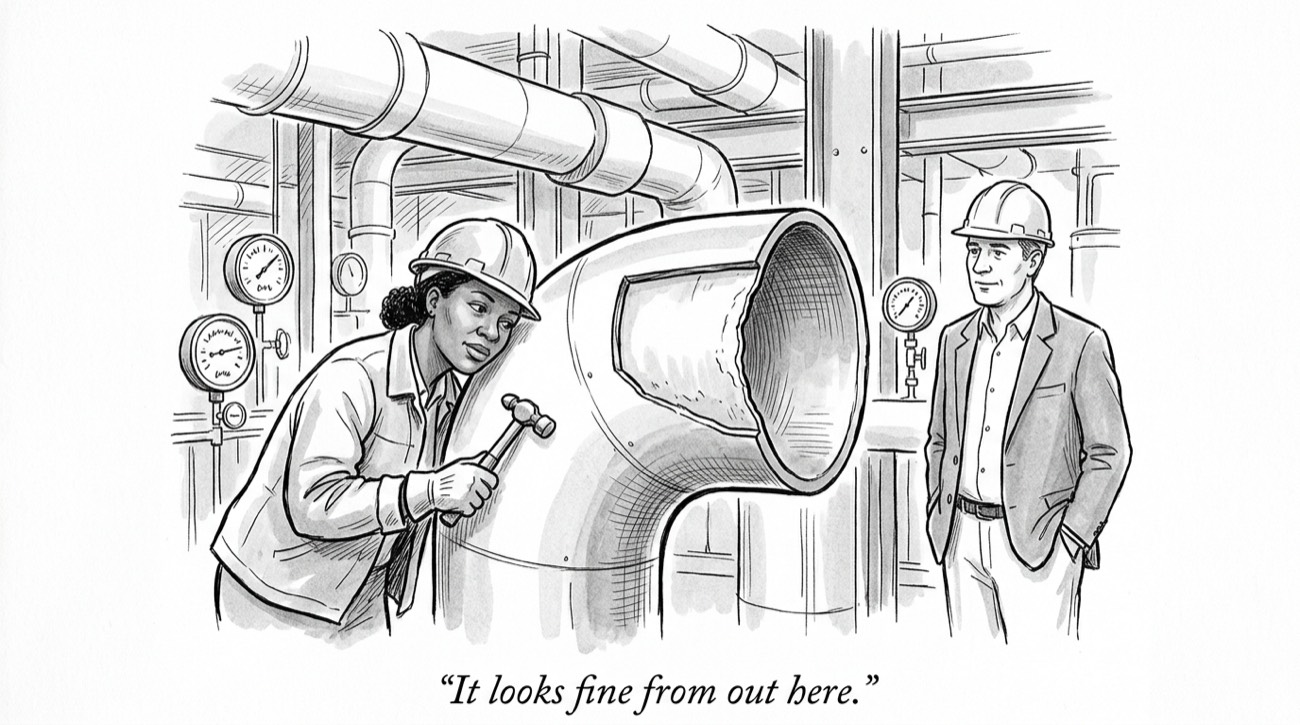
On December 9, 1986, an 18-inch pipe elbow at the Surry nuclear plant in Virginia ruptured. Four workers died of their injuries.[1] The pipe was carbon steel. It had been thinning from the inside for years, worn down by the water moving through it. Nothing on the outside showed it. That is what flow-accelerated corrosion does: it takes the wall away at bends and flow disturbances, and the pipe looks fine until the day it does not.
I know this because a flow-accelerated corrosion engineer I work with thinks about elbows the way other people think about weather. She taught me to look at a piping diagram and ask where the water changes direction.
Flint is the same failure at the scale of a city. In April 2014 Flint, Michigan, run at the time by a state-appointed emergency manager, changed its water supply from Detroit's system to the Flint River, a cheaper source, to save money while the city moved toward a new regional pipeline.[8] The river water was more corrosive, and the federally required corrosion control was not in place. Lead pipes began to corrode, and lead went into the water.[2] The governor's own task force concluded that the causes lie primarily at the feet of the state.[3] Researchers tied two outbreaks of Legionnaires' disease, in the summers of 2014 and 2015, to the same change in chemistry and the missing corrosion control.[2]
One detail from the reporting stays with me. A plant supervisor asked a state official how often staff would need to monitor phosphate, the chemical that keeps lead from leaching, and was told monitoring was not needed because the city was not required to add it.[4] That is one person's account, not a documented finding. But the shape is familiar: everyone assumed someone else was checking.
It is not only Flint. EPA projects about 9.0 million lead service lines in the United States, and that is a projection, because many water systems could not say what their pipes were made of when they were first asked.[5] About 43 million Americans drink from private wells, which the federal Safe Drinking Water Act does not regulate, and in one USGS study of about 2,100 of them, roughly 23 percent had at least one contaminant at a level of potential health concern.[6] And more than two million Americans lack running water, indoor plumbing or wastewater service, most often in communities of color, low-income rural areas and tribal communities.[7]
We tend to believe that someone is making sure the water is safe. For long stretches, in many places, that has been an assumption and not a measurement.
What a sensor company has to be right about. My team did a technical review for an investor in a company that makes water-quality monitors, instruments that sit on a utility's line and test the water all day. The company's pitch was the measurement gap: the water in the pipe is rarely tested as often as it should be, so put an instrument there. A flow-accelerated corrosion engineer sat in on the management calls with me, and we read the build diagrams together. I also called a microfluidics specialist, someone I once worked with, and asked him to fill in my blanks. I explained what I was looking at: an instrument that looked like a 3D printer working with fluids, a gantry and pipettes serving a microfluidic chamber, mixing small samples of water with reagents and measuring the reaction. He told me how to look at it, including how to analyze the reagents needed to measure a reaction. What I needed to know was how it would work in the field, not on a bench. We had lunch, and he taught me what I needed.

We asked what an engineer asks about any wet machine. What metals touch the water, and do they touch each other? What happens to the seals over years of use? If the fluid leaks, where does it go, and what is it next to? The instrument had a mix of metals, a sealant that had been changed partway through its life, and a gantry that positioned the pipettes and moved water around inside a box that also held the electronics, so a leak could reach them. The box was deployed outside. The gantry was the concern: electronics and water in one box, in the weather. None of that shows up in a demo. All of it decides whether the instrument is still telling the truth in year three. I have been bitten by mixed materials myself, in a different domain. At Eyeweb, part of our imager was steel and the back panel was aluminum, and grounding was an issue.
That is the point of the piece. The work required people who understood materials. A software reviewer reading the data pipeline would have passed this instrument, because the data pipeline was fine. It took an engineer who knows how metals, seals and moving water behave over years to see where it could fail. The same was true in Flint. The decision was framed as a question of cost, and the question that mattered was what the new water would do to the old pipes. That is a materials question, and the reporting suggests the people who understood it were not the ones deciding.
What we look at. When a deal depends on hardware that lives in water, steam or chemicals, we ask for the build diagram and the bill of materials, and we put someone who understands materials in the room. We ask what the system assumes about its environment and what it costs when the assumption is wrong. A report that says the technology works is the start of the work. Finding the pipe you cannot see takes someone who knows where to look.
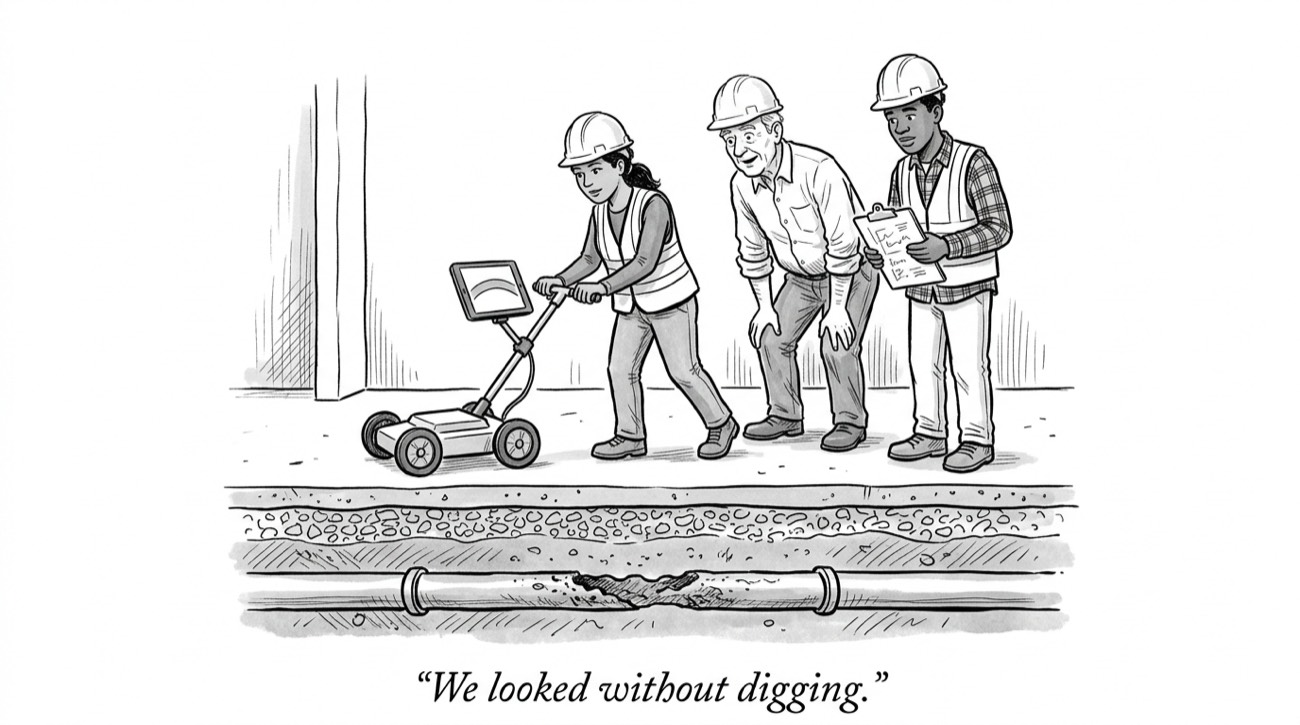
We also use ground-penetrating radar, and not for the same job. The corrosion engineer I work with uses it in nuclear plants. I have used it for server rooms. The goal is the same: to see what you cannot inspect. It shows what is buried or hidden before anyone cuts into a slab or a wall, which tells you where to look and where you can run conduit without hitting what is already there. I have had two internet providers run their links into a building from two separate sides. Each dug its own trench, and we pulled separate conduit to the server room. That is how isolation works: two paths that share nothing, not even a trench. The floor was concrete, and we had to know where to break it, so we used radar first. It shows where things are, not how much metal is left in them, so it is where the looking starts.
This is the author's account and is not investment advice.
Sources
- Surry Unit 2, December 9, 1986: NRC Generic Letter 89-08 attributes the failure of the feedwater piping to erosion/corrosion of the carbon steel wall, https://www.nrc.gov/documents-reports/generic-communications/generic-letters/1989/gl89008. Four workers died of their injuries; account by David Lochbaum, Union of Concerned Scientists, https://blog.ucs.org/dlochbaum/pipe-rupture-at-surry/ (secondary). NRC Bulletin 87-01 then asked plants about their pipe-wall thickness monitoring, https://www.nrc.gov/documents-reports/generic-communications/bulletins/1987/bl87001.
- Flint switch, corrosion and Legionnaires' outbreaks: peer-reviewed paper, https://par.nsf.gov/servlets/purl/10299772.
- Flint Water Advisory Task Force, final report, March 21, 2016, as summarized at https://environblog.jenner.com/2016/03/23/flint-water-advisory-task-force-issues-final-report/ (secondary; the report itself was not opened).
- The phosphate exchange is the plant supervisor's account as reported by the Associated Press; it is not an independently documented finding. Consultant's recommendation of a trial period and corrosion controls, disputed by the consultant: https://enr.com/articles/39139-water-engineer-says-flint-ignored-anti-corrosion-ideas.
- EPA, 7th Drinking Water Infrastructure Needs Survey and Assessment: 9.2 million projected lead service lines in the original 2023 report, revised to 9.0 million in the 2023 update, https://www.epa.gov/dwsrf/epas-7th-drinking-water-infrastructure-needs-survey-and-assessment. A projection, because many systems could not confirm their pipe materials.
- USGS, private (domestic) wells: almost 43 million people in 2015, not regulated by the Safe Drinking Water Act; 2009 study of about 2,100 wells, about 23 percent with at least one contaminant of potential health concern, https://www.usgs.gov/mission-areas/water-resources/science/domestic-private-supply-wells.
- DigDeep and US Water Alliance, Closing the Water Access Gap in the United States, November 2019, https://www.digdeep.org/s/Dig-Deep_Closing-the-Water-Access-Gap-in-the-United-States_DIGITAL_compressed-2hyx.pdf.
- Cost as the stated reason for the switch: the city's own 2015 water Q&A called the river a safe and financially responsible alternative, https://www.cityofflint.com/wp-content/uploads/CoF-Water-System-QA.pdf. Whether the switch actually saved money was contested at the time (Detroit's water department projected its own offer would be cheaper over 30 years; see Metro Times, https://www.metrotimes.com/news/new-emails-reveal-the-switch-to-the-flint-river-was-not-about-saving-money-2392370/, an advocacy-leaning investigation); Bridge Magazine reported the city's water costs did fall after the switch while residents kept paying high rates, https://bridgemi.com/michigan-government/flints-switch-river-water-left-residents-holding-tab/.
The method and the questions are the author's own. The Eyeweb account is the author's own. No client's name or figures are used.